Conservation: think big, start small, act now
Updated: Feb 3, 2025
General Johan Jooste and Tony Park, authors of “Rhino War”, have captured the essence of conservation in that phrase. Let’s break it down (in reverse order) and more importantly, take it forward.
‘Act Now’: as we approach the end of year festive season, it is the perfect time to reflect on what actions we (can) take to help our planet.
‘Start Small’: Conservation is not necessarily achieved through grand projects - it is about the small choices we make and actions we take daily. Small changes, big impact.
Reports that Temu and Shein account for c. 20% of parcels in some Western countries; or that the sale of electric vehicles nosedived without subsidies are disheartening. I prefer to focus on the small steps that people now take: like sorting their trash, leaving wild patches (meadows) in their gardens, or swapping car trips for walking or biking.
In this festive period, consider a mindshift: could we not replace our consumerization (material gifts) with experiences or purposeful contributions. Instead of buying a sweater, pair of socks or a toy (all clog our wardrobes), what if 10% of gifts to our loved ones went toward Conservation or Impact. Our mailboxes abound with requests for donation. Act now.
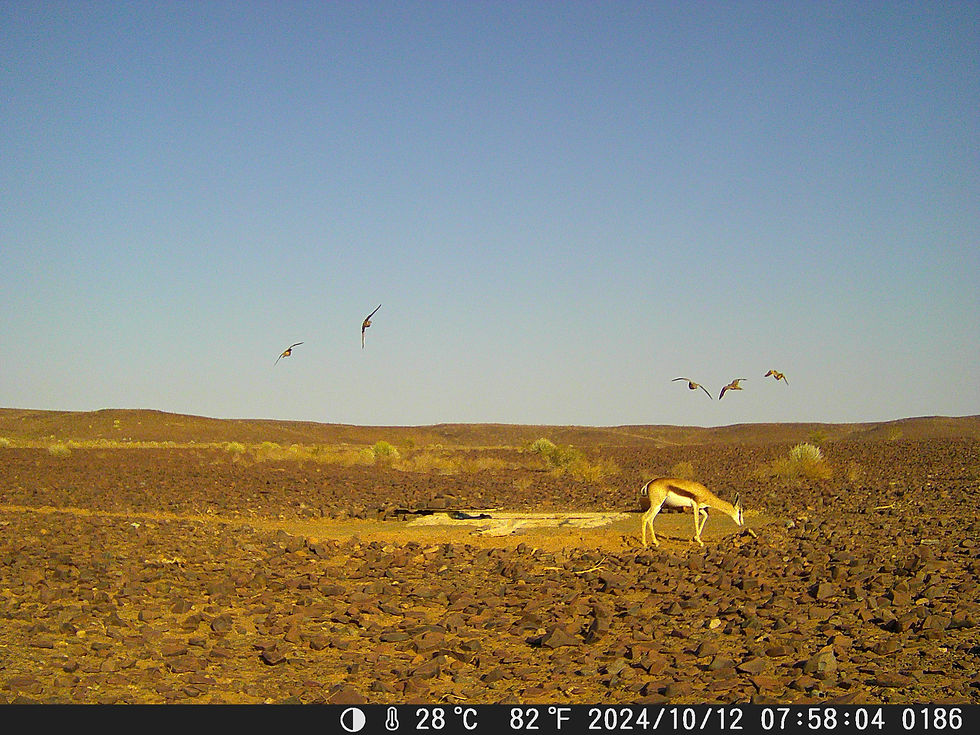
Our Act Now: introduce 2-3 groups of mostly female/cow springbok (donation page, eGift). We observe an increasing number of kudus, zebras and smaller game that have become more familiar with our land, yet springbok should be in much greater numbers. Like other animals, they are a natural and efficient way to keep vegetation healthy and spread seeds.
In 6 weeks (Sept. 7 - Oct. 20), we had over 70 pictures of kudus (camera trap set to operate from 5pm until 8am, with time lapses)
and 100+ snapshots of zebras, incl. Eeyore (Winnie's friend without a tail). All taken at our '90M borehole'
In the tech world, agility is king. And that mindset translates naturally to Conservation. So, we have embraced this approach. I used the slide below in our original presentation. Our goal is to beat that timeline.

Nature and the harsh environment of Namibia dictate resourcefulness. In our field research (3 days onsite this past October) with Cornelis van der Waal, John Mendelsohn, and Derick Greyling, a number of questions and actions quickly surfaced: what is the baseline of every ‘biome’ in the absence of livestock? How much time will it take for Nature to show itself?
We are therefore about to run simple yet powerful experiments:
Construct several fenced enclosures to understand the effect of (excluding) large animals (despite our best efforts to take fences down)
Collect soil samples from different areas. Test different treatments: leave as is, drip irrigation, or drip irrigation+manure
Retain rainfall, digging bunds/smiles, placing gabions, hindering run-offs by roads and tracks
Continue irrigation trials at different points (ensuring a rotation) and evaluate the response from flora and fauna to the limited availability of green forage
Wonder about the things you do not see:
why are we not seeing many geckos or snakes?
Why are there certain areas with unexpected vegetation or rock sediments (the dolomite in the picture stands out)
Analyze whether the animals caught on camera are resident/regulars, increasing in numbers (we see more ‘groups’), mostly female who may drop their offsprings on the property and create a bond
Start an ‘event book’: log any observations
It is all about insights and moving closer to the path that Nature originally intended. Yes, we make mistakes, though not for lack of trying. Biodiversity restoration is action and iteration.
‘Think Big’ is the NorthStar. Both in terms of timeline (conservation is a long game, 20 years minimum) and in ambitions. Learnings from Allan Savory (holistic management), Peter Andrews (Mulloon Creek, Australia), or rewilding with Knepp Estate in the UK remind us that bold, unconventional ideas are the seeds of transformation.
Our vision is to contribute to a conservation area in Southern Namibia that unites Gondwana, Fish River Canyon and the larger Nama Karoo biome. An area that spans 500’000ha (5’000km2) recreating the land that once saw the migration of millions of springbok as well as megafauna: elephants, black rhinos and giraffes.
Thinking Big though is not about scale. It’s about asking the right questions and removing blindspots. What if colonization had not disrupted ecosystems? What if landscapes had not been overgrazed by livestock? What could this land look like 100 years from now? What was it like 200 years ago?
Our knowledge of Nature has grown a lot over the last decades, assisted by research and technology. These ‘What ifs’ fuel our aspirations and guide us forward.
Let’s have a positive impact on how Löwen River Rewilding will look in 2 years already.


Comments