Carrying Capacity
We’re not fully booked yet! There is room to grow.
As we look at the sky bracing for the rainy season—and quietly root for aftergrowth miracles—it’s time to talk about carrying capacity.
Over the coming months, Gift and Bernardo—our two brave interns—will help turn boots-on-the-ground observations into usable data. With a bit of luck (and battery life), a high-definition drone may soon join the effort. But even before the spreadsheets arrive, it helps to know what the land can sustain. Think of it as an ecological North Star.
To set the scene, we lean on the work of friends of Löwen River Rewilding—Cornelis van der Waal and his co-authors of the Photo Guide to Estimate Forage Availability in Namibian Rangelands. Sometimes, a trained eye gets you surprisingly far. Let alone three pairs 👀

According to vegetation zones defined by Kruger, van der Waal and Wittneben, Löwen River sits within the Dwarf Shrub Savannah. Here, forage availability ranges from as little as 10kg to a lush 950kg of dry matter per hectare. Nature, as always, enjoys a wide spread.
10kg dry matter picture
The most accurate way to estimate forage involves clipping, drying, and weighing, repeatedly across multiple plots. It works—and it’s also slow, expensive, and labour-intensive. In the spirit of pragmatic rewilding, we rely on the Photo Guide as a reasonable middle ground. We conservatively assume 100kg of dry matter per hectare across 60% of the land, today.
On 12,750 hectares, this yields 762,000kg of available forage.
Enter the benchmark: a 450kg bovine requires roughly 4,000kg of dry biomass per year, the definition of a Large Stock Unit (LSU). Divide the available forage by the calorie count and the math is simple: 190 LSU. In short, Löwen River can easily sustain this load with the current vegetation.
For perspective: one LSU corresponds to about 40 hectares of land just to meat (=meet) annual feed requirements. That’s before accounting for water, shade, or freedom of movement.
Sheep, by comparison, stand at roughly 0.15 LSU, consuming about 600kg of dry matter per year. They are versatile feeders—grazing grasses when available and browsing shrubs in drier times. Records by the local authorities show that, in the 1960s and 70s, Löwen River carried over 2,200 sheep. Without rotational grazing and with animals concentrated around a handful of boreholes, overgrazing was inevitable. The land still carries the imprint.
Today, soil compaction, reinforced by erratic and often violent rainfall, remains one of Löwen River’s key challenges. We know what recovery can look like. Gondwana next door, largely free of cattle for the past 50 years (they missed the high-fashion periods of karakul garment between the 1960s to 1980s), offers a quiet yet compelling benchmark.
Assuming a balanced mix of wild herbivores with an even split of available fodder, Löwen River Rewilding could already support as many permanent residents as:
80 zebra
120 kudu
160 oryx
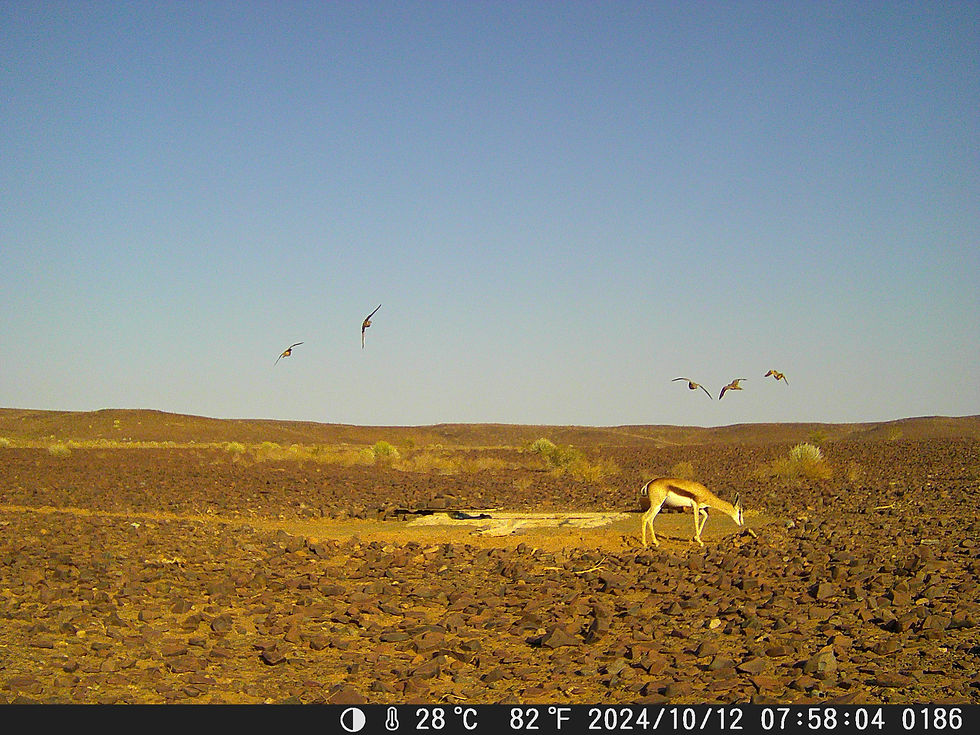
470 springbok
Roughly 830 four-legged ecosystem engineers—grazers and browsers whose movement loosens soil, spreads seeds, and restores processes perfected over thousands of years.
For decades, cattle farming - in its competition with wildlife - prevented that reality. Our reintroduction of a social group of 20 springbok by end June 2026 and the start of the winter is our first milestone. This step implies the construction of a 150m x 150m enclosure (boma) for acclimatization. It also requires additional funding (GoFundMe).
Next to this undertaking of cautiously returning fauna, our other priority remains triggering vegetation growth—half-moons, gabions, greenhouse work. While we dream that more parts of the property return to forage availability of 330kg per hectare.
All realistic.
Rewilding rarely rewards haste.
Hard work and patience scale better.


Comments