Foundational 2025
Building the base. Testing assumptions. Letting nature answer back.
2025 marked a pivotal year for Löwen River Rewilding.
Our first official step away from decades of livestock farming — and into the slow, deliberate work of restoration in the heart of Namibia’s Nama Karoo.
Our mission has always been ambitious. Occasionally reckless. (Timeless Reflection)
So year-end evaluations arrive as a familiar cocktail: pride, impatience, and a healthy dose of “we’re just getting started.”
Here’s how the year unfolded.
🌱 Mapping Life in the Nama Karoo
Vegetation (Green Shoots & Gravel Plains) remains the bedrock of our rewilding work. In 2025, the priority was simple in theory and complex in practice: establish a baseline — flora first, fauna second.
Rain helped. A lot.
Between Q1 showers, late winter rains in September–October, and the opening of the Naute Dam sluices (Dam!), we had a rare opportunity to validate our assumptions:
Where does water actually flow?
How does the soil erode — or hold?
Are viable seeds still hiding in the soil?
How dramatically does rainfall vary by topography?
Short answer: a lot more than spreadsheets suggest
The flip side? Abundance complicates reliable measurement. With water and green shoots spread across vast areas, wildlife concentration dropped — great for ecosystems, terrible for neat data sets.
Still, through field surveys, camera traps (Bits & Atoms), spoor tracking, and literature reviews, Chamaites counts a log of:
800+ plant species, including
25 grasses
84 tree species
400+ hardy shrubs
~60 reptile species
~50 mammal species, from large ungulates to specialist small mammals
The next generation also made itself known. Zebras (including Eeyore) returned, along with a tower of seven female kudus regularly visiting our 90 m borehole. Individual IDs remain tricky, but patterns are clear: these are no one-time visitors — they’re regulars.
Porcupines, aardvark, mongoose agree.
Leopards and brown hyena? Free-roaming, as expected — their territories span well beyond our boundaries. Cape foxes and wild cats keep things discreet.
🛠️ Taking Down Barriers: 20 km of Freedom
One of the most tangible wins of 2025: removing 20 km of internal fencing.
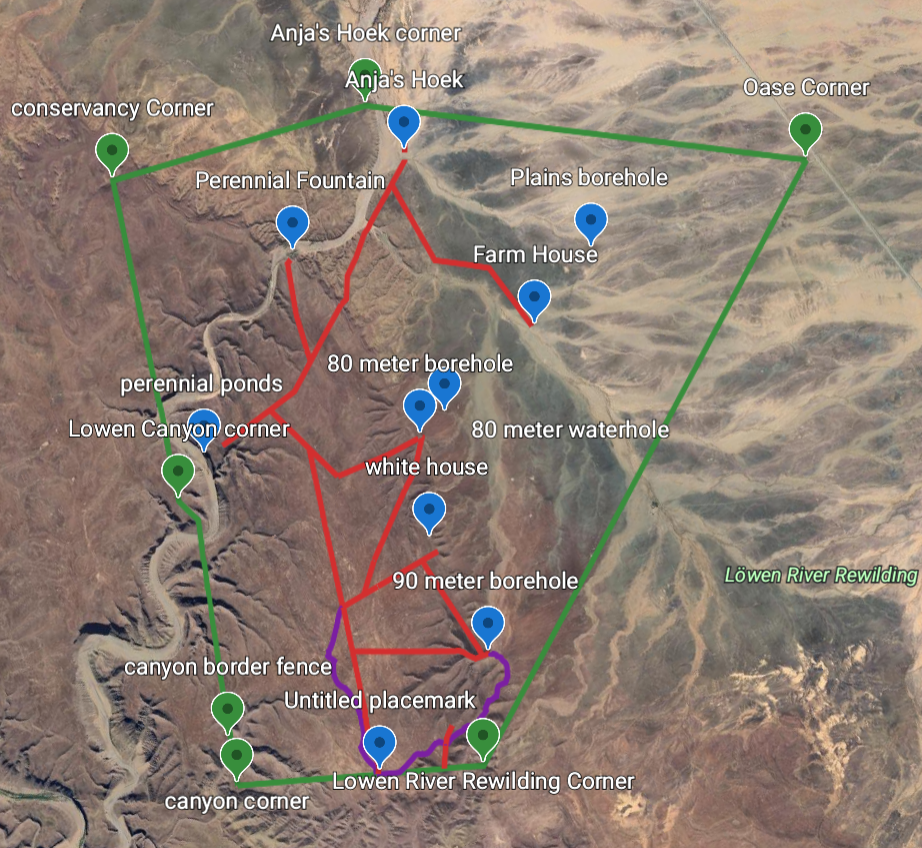
For decades, these wires restricted movement — livestock and wildlife alike. Their removal triggered near-instant results: animals appeared in areas untouched for years.
Movement matters. Ungulates:
disperse seeds
loosen compacted soil creating micro-habitats through trampling
Rewilding, it turns out, has four legs and excellent hooves.
The flip side of openness is vigilance.
Internal fences down means perimeter protection up.
Wildlife welcome. Human trespassers beware.
Our team patrolled relentlessly — often at inconvenient hours — removing 40+ snares along riverines and boundaries. Few were recent, but the reminder is sobering: snaring is indiscriminate, cruel, and driven by poverty and decades of inaction.
Encouragingly, birdlife and small mammals (hares included) rebounded quickly. Pressure off → life returns.
And yes — even bees noticed. Pollinators congregated around borehole humidity, quietly doing what they do best.

💧 Engineering Resilience: Water & Soil
To slow erosion and “irrigate”, we focused on three pillars:
vegetation regeneration, erosion control, water saturation.
2025 marked the birth of our nursery and the commissioning of our greenhouse — a deliberate move toward propagating endemic species at scale.
Using repurposed fence wire and local stone, we built:
bush-packing structures to slow runoff
gabions to trap sediment and water
The goal: when rain falls, let it sip — not sprint — through the soil.
Half-moons (bunds) also entered the mix — effective, proven, and brutally labour-intensive. One manually dug bund (3 m wide, 30–50 cm deep) means moving ~2 tons of soil and rock. With a spade.
Water infrastructure quietly levelled up:
5 boreholes live
solar-powered pumps
5,000 L jojos (at each borehole)
timed sprinklers and troughs
new piping to eliminate leaks
Optimising this system — intermittent power, extreme heat, evaporation — is trivial in cities. In remote southern Namibia? It’s an engineering puzzle with consequences.
🏠 Infrastructure: Going Far Together
Beyond ecology, 2025 invested in people.
Steven’s house received:
insulation, windows, repaired roof
bathroom
solar panels and batteries
proper shelter for up to three team members
The farmhouse followed suit — patched roof, tiled floors, renovated bathroom, and a 10 kVA solar system powering pumps, shower, and the all-important fridge/freezer. When groceries are 80 km away, cold storage matters.
“If you want to go fast, go alone.
If you want to go far, go together.”
Rewilding is exactly that tightrope:
social + biological + operational + financial, walked deliberately.
Verdict: a strong year. Solid B+.
Which means expectations are higher for 2026.
🔭 2026: From Foundation to Momentum
Building on what’s in place, the next 12 months aim to accelerate — carefully.
🌍 Biodiversity
Reintroduce ~30 springbok and 10 oryx (min. social groups)
Strengthen gene flow and ecological function
Cosy up with like-minded neighbours (Gondwana, ERP) to take down perimeter fences
🔬 Research
Sponsor two NUST Bachelor students (Jan–May) on their research:
Ant Warfare & Foraging in an Arid Landscape
Tracking Invasive Alien Plants
🧱 Resilience
Scale bush-packing, gabions, and bunds
Invest in a tractor / TLB
Secure sponsor funding to amplify the team’s work
All while showcasing southern Namibia’s pristine ecosystem — shaped over hundreds of millions of years, yet urgently in need of care.
2025 laid the foundations.
2026 builds momentum.


Comments